

Are Gas Powered Go Karts EPA Compliant?
When shopping for a gas-powered go kart, the key question is: Are gas powered go karts EPA compliant? Many are, but not all. The EPA sets specific emission standards for small engines, and compliance matters more than most buyers realize.
At SalePriced, every gas-powered go kart meets EPA regulations, ensuring legal operation and air quality compliance. Understanding what compliance means and how to verify it separates informed buyers from those stuck with non-compliant equipment.
The MotoTec Sandman Gas Go Kart features a 49cc 2-stroke EPA-approved engine, reflecting engineering choices in emissions control and fuel efficiency that ensure environmental responsibility and reliability.

MotoTec Sandman Gas 49cc Go Kart for kids Black
EPA vs. CARB Compliance Explained
The EPA sets national emission standards for small engines under 25 horsepower, regulating nitrogen oxides and hydrocarbon release. CARB (California Air Resources Board) sets stricter standards for California and several other states.
EPA compliance meets the federal baseline; CARB compliance meets a higher standard. If you live in a CARB state (California, Connecticut, Delaware, Maine, Maryland, Massachusetts, Minnesota, Nevada, New Jersey, New Mexico, New York, Oregon, Rhode Island, Vermont, or Washington), you need CARB compliance. Elsewhere, EPA compliance is required.
Most manufacturers design for EPA standards as the larger market. CARB compliance costs more and is typically reserved for premium models. Check product descriptions or the engine's certification label to verify EPA or CARB approval.
Engine displacement matters: a 49cc 2-stroke engine falls under EPA jurisdiction, while larger engines (150cc-200cc) require more sophisticated emissions control systems like catalytic converters.
How to Verify EPA Compliance on Your Go Kart
Verification starts with the certification label. Every EPA-compliant small engine has a permanent label attached to the engine block or frame. This label displays the manufacturer's name, engine model, displacement, and crucially, the EPA certification number. If you can't find this label or it's missing, the engine is not certified.
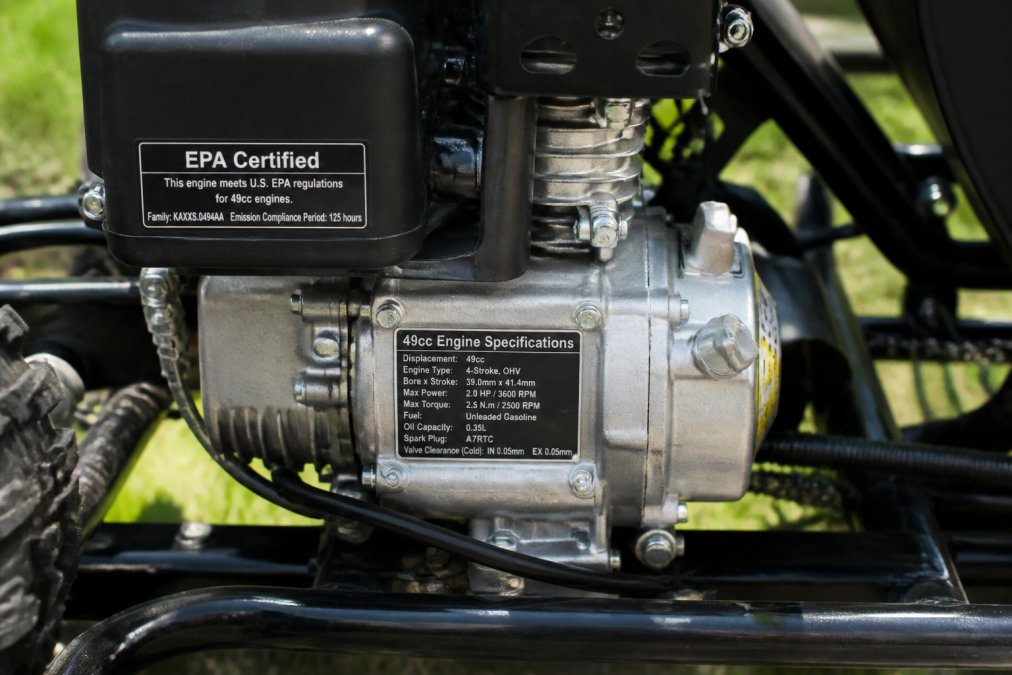
Close-up of a gas-powered go kart's 49cc engine showing the EPA certification label and manufacturer specifications plate mounted on the engine block with clear, legible text visible
When receiving a go kart, inspect the engine label before assembly. It should be permanent and tamper-proof. If it peels off easily, that's a red flag; legitimate manufacturers bond labels directly to the engine.
Cross-reference the EPA certification number against the EPA's online database for absolute certainty; the process takes five minutes.
Check product documentation for compliance information. If the manual lacks EPA compliance details, ask the seller for proof before purchasing.
Gas Powered Go Kart Safety Standards
EPA compliance addresses emissions; safety is separate. Gas-powered go karts for kids must meet ASTM F963 standards covering structural integrity, sharp edges, and hazard warnings. SalePriced ensures all ride-on toys for children up to 12 years old meet ASTM F963 CPSC Toy Safety requirements.
The MotoTec Sandman includes a padded seat with seat belt, rear disk brakes, and sturdy steel frame, combining EPA compliance with safety for young riders.
The Sandman is designed for riders 13 and up, reflecting its 32 mph top speed and required cognitive ability. Matching the go kart to the rider's age and skill level is as important as checking the EPA label.
Safety FeaturePurposeImpactPadded seat with beltRider securityPrevents ejection during turns or stopsRear disk brakesStopping powerAllows controlled deceleration on varied terrainSteel frameStructural integrityProtects rider in minor impactsRoll cage (on some models)Impact protectionReduces injury risk in rollover situations
How to Maintain Gas Powered Go Karts for Compliance
A well-maintained EPA-compliant engine stays compliant only if unmodified. Understanding what maintenance preserves compliance and what modifications void it is essential for legal operation.
Routine Maintenance That Preserves Compliance
Use the correct engine oil (typically 4-stroke SAE 30 or 10W-30) and change it every 50 operating hours or once per season. Wrong oil increases emissions and accelerates wear; correct oil maintains EPA compliance.
Inspect the air filter every 10 operating hours and replace if dirty. A clogged filter forces rich running (too much fuel, not enough air), increasing emissions. Always use OEM air filters; aftermarket filters can alter the air-fuel ratio and exceed EPA limits.
Use fresh gasoline and don't store fuel longer than 30 days without stabilizer. Old fuel creates gum deposits, disrupting the air-fuel ratio. For winter storage, drain the tank or add stabilizer. Avoid ethanol-blended fuel (E10 or higher) unless the manual allows it.
Replace spark plugs annually or if the engine starts hard or runs rough. Use only the type specified in the manual; wrong plugs alter combustion and increase emissions.
Modifications That Void EPA Compliance
Any modification to the fuel system, air intake, or exhaust system voids EPA compliance immediately. The certification applies only to the original configuration.
Common modifications that void compliance include: exhaust system changes (removing mufflers, installing aftermarket exhausts), air intake modifications (high-flow filters, cold-air intakes), carburetor tuning, ignition timing adjustments, engine displacement changes, and fuel system modifications. Always use OEM components.
Why Modifications Matter Legally
MotoTec Sandman Gas 49cc Go Kart for →
Operating a modified engine carries fines of $300 to $5,000 per day in federal enforcement areas, plus state-level fines. The EPA considers modified engines violations of the Clean Air Act.
If your go kart is involved in an accident and the insurer discovers engine modifications, coverage may be denied for operating illegal equipment.
Replacement Parts and Compliance
Always use OEM parts or certified equivalents; aftermarket parts may have different tolerances affecting emissions. Document all replacements with receipts and part numbers to prove compliance maintenance.
Storage and Seasonal Maintenance
Before storing for more than 30 days, drain the fuel tank or add stabilizer, and change the oil. Store in a dry location. When restarting, inspect for leaks, check oil, and listen for unusual sounds. If the engine runs rough or produces excessive smoke, have it serviced before operating.
Consequences of Non-Compliance
Operating a non-EPA-compliant gas-powered go kart carries real legal and financial penalties that vary by jurisdiction and enforcement approach. Understanding these consequences helps buyers recognize why compliance matters beyond environmental responsibility.
Federal Enforcement and Penalties
The EPA enforces small engine emission standards under the Clean Air Act. Manufacturers and importers who sell non-compliant engines face federal penalties up to $43,792 per violation (as of 2024, adjusted annually for inflation). While these fines target manufacturers rather than individual consumers, they drive up the cost of non-compliant equipment or push sellers to operate in gray markets where compliance documentation is falsified.
Individuals caught operating non-compliant small engines in areas with active EPA enforcement can face fines ranging from $300 to $5,000 per day of operation, depending on whether the violation is deemed negligent or knowing. The EPA prioritizes enforcement in non-attainment areas, regions that fail to meet National Ambient Air Quality Standards, which include parts of California, Texas, Pennsylvania, and the Northeast Corridor.
State-Level Enforcement
Many states have adopted their own small engine emission regulations that mirror or exceed EPA standards. California's CARB program is the most aggressive; operating a non-CARB-compliant engine in California can result in fines of $250 to $1,000 per violation, plus equipment confiscation. Other states with active enforcement include New York (fines up to $500 per violation), Massachusetts (up to $300 per day), and Colorado (up to $500 per violation in Denver and surrounding counties).
Local air quality management districts in non-attainment areas sometimes conduct equipment inspections at recreational facilities, parks, and private properties. If a go kart fails inspection, operators face immediate shutdown orders and fines. Some jurisdictions require proof of compliance before registering recreational equipment or obtaining permits for use on public land.
Insurance and Liability Gaps
Non-compliance creates insurance exposure that many buyers don't anticipate. If a go kart is involved in an accident and the insurance company discovers the engine is non-certified, the policy may deny coverage on grounds that the operator was using illegal equipment. This denial applies not only to the go kart damage but potentially to third-party liability claims if the accident injures another person.
Homeowner's insurance policies often exclude coverage for recreational vehicles that violate environmental regulations.
Import and Resale Restrictions
Practical Consequences Beyond Fines
Choosing an EPA-Compliant Go Kart
Start by confirming EPA compliance in the product listing. Legitimate retailers like SalePriced clearly state compliance status. If it's not mentioned, ask before buying. Don't assume a go kart is compliant just because it's available for sale, some sellers import non-compliant models from overseas.
- EPA certification label clearly visible on the engine
- Compliance mentioned in product documentation
- Age recommendations that match your rider's skill level
- Safety features like seat belts and brakes
- Retailer transparency about compliance status
- Warranty coverage (SalePriced offers 30-day parts replacement warranty)
Frequently Asked Questions
What does EPA certification mean for small off-road engines?
EPA certification confirms that a small engine meets federal emission standards set by the Environmental Protection Agency. For go karts, this means the 4-stroke or 2-stroke engine produces emissions within allowable limits for non-road equipment. Certified engines have a permanent label on the engine block stating compliance. This certification applies to recreational vehicles used on private property and ensures the engine won't contribute excessively to air pollution. All EPA-compliant go karts must carry this verification label as proof.
Do all gas-powered go-karts require EPA approval?
Not all gas-powered go karts require EPA approval, but most modern ones sold in the U.S. do. The EPA requires certification for small engines (under 25 horsepower) used in recreational off-highway vehicles. However, go karts used exclusively on private property may have fewer restrictions than those intended for street use or commercial operation. Always check the manufacturer's documentation and the certification label on the engine. SalePriced's gas-powered go karts, including the MotoTec Sandman 49cc models, are EPA approved and clearly labeled for compliance.
Are gas-powered go-karts illegal?
Gas-powered go karts are not inherently illegal, but their legal status depends on use and location. Private property use is generally permitted without street registration. However, using a go kart on public roads, highways, or in areas with strict emission regulations may violate local or state laws. Some states and counties have additional restrictions beyond EPA standards, particularly in air quality management districts. Always verify local regulations before purchasing. EPA-compliant models reduce legal risk significantly, as they meet federal emission requirements that many jurisdictions recognize.
How do I know if a go kart is actually EPA compliant?
Look for the EPA certification label permanently attached to the engine block or frame. This label lists the engine displacement, horsepower, and certification number. Check the manufacturer's documentation and product specifications for mention of EPA approval. Request a compliance report or certification document from the seller. Reputable retailers like SalePriced provide clear EPA compliance information in product listings. Never assume compliance based on appearance alone. Contact the manufacturer directly if documentation is unclear or missing before making a purchase.
0 comments