

Table of Contents
- What Is ASTM F963 and Why It Matters
- Scope: Which Products Fall Under ASTM F963
- CPSC Toy Safety Requirements and Mandatory Compliance
- Key Safety Hazards Addressed by the Standard
- ASTM F963-23 Testing Procedures Explained
- How to Verify Toy Safety Compliance
- Common Compliance Failures and How to Avoid Them
- Frequently Asked Questions
Last Updated: September 30, 2026
What Is ASTM F963 and Why It Matters
The ASTM F963 toy standard is the consumer product safety standard that governs toy design, manufacturing, and testing for children under 14. Officially titled "Standard Consumer Safety Specification for Toy Safety," this standard sets mandatory requirements for mechanical properties, flammability, chemical toxicity, and hazard identification. If you're a parent shopping for ride-on toys, dirt bikes, or go-karts for kids, understanding what ASTM F963 means is the difference between a safe purchase and a potentially dangerous one.
Toys pose real hazards: choking from small parts, lacerations from sharp edges, burns from flammable materials, and toxic accumulation from heavy metals like lead and cadmium. The Consumer Product Safety Commission (CPSC) enforces ASTM F963 compliance, and violations result in recalls, fines, and liability.
This article explains what that means, how testing works, and what to verify before buying.
Scope: Which Products Fall Under ASTM F963
ASTM F963 covers any product designed or marketed for children under 14, including ride-on toys, pocket bikes, go-karts, and electric scooters. It does not apply to adult products, even if children might use them.
A pocket bike marketed for ages 8-12 must meet ASTM F963 requirements. The same bike marketed as "adult recreation" falls outside the standard's scope, though other regulations may apply.
CPSC Toy Safety Requirements and Mandatory Compliance
Compliance with ASTM F963 is mandatory. The Consumer Product Safety Commission enforces this through 16 CFR 1250, requiring every toy sold to have a Children's Product Certificate (CPC) (Toy Safety Business Guidance). Penalties for non-compliance include product seizures, fines up to $100,000 per violation, and criminal liability.
The Children's Product Certificate (CPC) Workflow
Understanding the CPC process is essential for anyone bringing a toy to market. Here's the practical sequence:
Step 1: Select a CPSC-Accredited Laboratory. Hire a third-party laboratory accredited by the CPSC (listed on the CPSC website). Non-accredited labs' results are not legally valid. Accredited labs know ASTM F963-23 protocols and can guide you on which tests apply.
Step 2: Submit Product Samples for Testing. Provide production samples (not prototypes) manufactured with the same processes, materials, and suppliers as your final product. Testing takes 4-8 weeks; longer for electrical components.
Step 3: Receive the Test Report and CPC. The laboratory issues a detailed test report with results for each hazard category and a CPC, a legal document certifying ASTM F963 compliance. The CPC includes the product model number, test date, laboratory accreditation number, and test methods used.
Step 4: Maintain Documentation and Traceability. Keep records of the CPC, test report, MSDS sheets, supplier certifications, and material lot numbers. Regulators will request this if a product is found non-compliant or causes injury. Maintain records for at least 5 years.
Step 5: Communicate the CPC Through the Supply Chain. Manufacturers must provide the CPC to retailers. Retailers must request and verify it before accepting inventory. Importers must obtain the CPC from the foreign manufacturer or re-test domestically.
Cost and Timeline Implications
Testing costs $2,000-$5,000 for simple ride-on toys, $4,000-$8,000 for battery-powered toys, and up to $10,000 for multi-material toys. These are per-product-model costs; design changes may require re-testing.
From sample submission to valid CPC typically takes 6-10 weeks.
Retailer Responsibility
Retailers must request the CPC from suppliers and verify compliance. The CPSC can fine retailers, seize inventory, and hold them liable for injuries. Reputable retailers request detailed documentation and audit suppliers.
Common Documentation Mistakes
Common errors include: testing only prototypes (not production samples), failing to maintain records, not re-testing after design changes, and assuming a CPC applies across markets. Each error creates legal exposure.
Key Safety Hazards Addressed by the Standard
ASTM F963 addresses eight hazard categories: mechanical (sharp edges, small parts), flammability (fabric and coating burn rate), chemical (lead, cadmium, phthalates), electrical (shock, battery containment), thermal (burn surfaces), and labeling (warnings, age recommendations, assembly instructions in English).
ASTM F963-23 Testing Procedures Explained
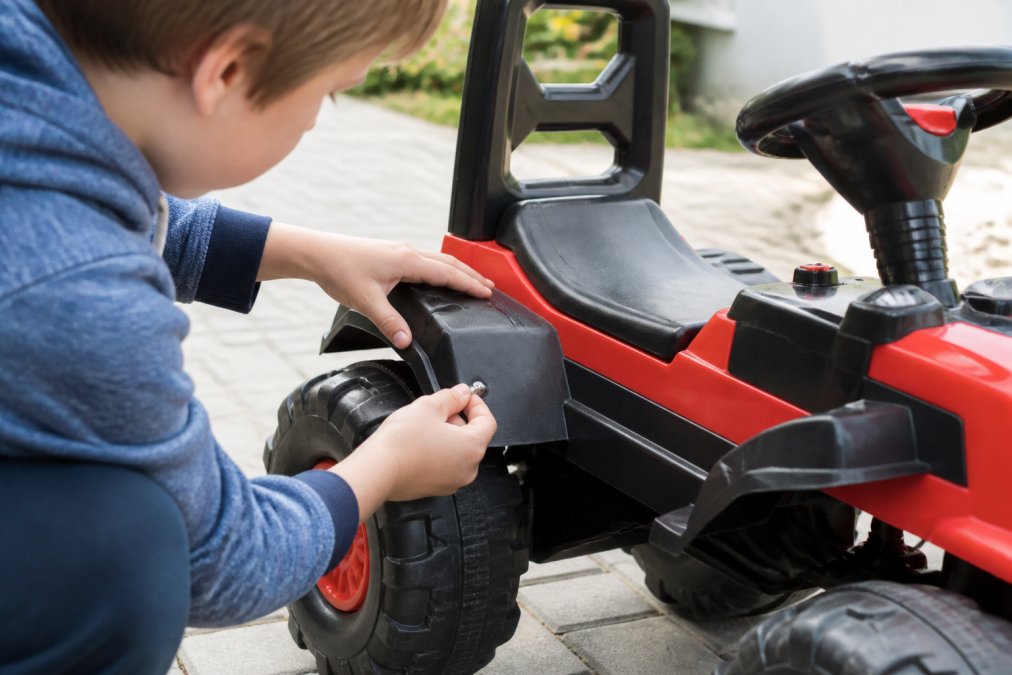
ASTM F963-23 specifies exact test methods: probe tests for small parts, edge gauges for sharpness, flame exposure for flammability (12 seconds; must self-extinguish within 5 seconds), chemical extraction for lead (limit 100 ppm) and cadmium (limit 75 ppm), and electrical testing for shock protection. All tests use physical samples, not designs.
How to Verify Toy Safety Compliance
Before buying a ride-on toy, verify compliance yourself. Here's what to check and what to do if something seems off.
The Certificate of Compliance: What to Request and What to Look For
Request the full test report, not just a summary. A reputable retailer provides the CPC (one page) and detailed test report (10-30 pages) including product model, lab name and accreditation number, test date, ASTM F963 version, pass/fail results for each hazard, specific measurements, and material lot numbers. If a retailer cannot produce this, it's a red flag.
Verify the Testing Laboratory
Verify the laboratory is CPSC-accredited by checking the CPSC's list. If not listed, the test report is invalid. Also check the lab's accreditation scope, it may be accredited for electrical testing but not chemical testing.
Red Flags in the Supply Chain
Unusually low pricing. If a toy costs 30-50% less than competitors, testing may have been skipped. This savings comes from your child's safety.
What to Check on the Product Label
The toy should have a permanently affixed label listing:
- Age recommendation (e.g., "Ages 5-10")
- Warnings about specific hazards (e.g., "Small parts. Not for children under 8." or "Choking hazard.")
- Manufacturer's name and address (or importer's name and address if the toy is imported)
- Model number (so you can match it to the test report)
- Care and assembly instructions (if applicable)
Labels should be in English and clearly visible. They should not be printed on a sticker that can be easily removed; they should be embossed, engraved, or printed directly on the product or a permanently attached tag.
Check for Recalls
Visit the CPSC website and search for recalls on the specific product model. If a product has been recalled, it should not be sold, and retailers should have removed it from inventory. If you find a recalled toy being sold, report it to the CPSC. Recalls are issued when a toy is found to be non-compliant or has caused injury in the field.
Ask About Component Testing
For ride-on toys with multiple components (wheels, fasteners, electrical systems, seat covers), ask the retailer or manufacturer:
- "Were components tested individually before assembly?"
- "Do you have certifications from your wheel supplier, battery supplier, and paint supplier?"
- "What happens if a component fails in the field? Do you have a recall procedure?"
Cost-Benefit: Why Compliance Matters
A compliant toy costs more upfront because testing, documentation, and quality control add expense. A non-compliant toy may cost 20-40% less. However, the cost of non-compliance is severe:
- Medical costs. A child injured by a toy may require emergency care, surgery, or long-term treatment. Medical costs for a serious injury can exceed $100,000.
- Liability. If a retailer sells a non-compliant toy and a child is injured, the retailer can be sued. Liability settlements often exceed the retailer's profit margin on the toy.
- Regulatory fines. The CPSC can fine retailers and manufacturers $100,000 or more per violation.
- Reputational damage. A retailer associated with an unsafe product loses customer trust and may face boycotts.
Common Compliance Failures and How to Avoid Them
Certain mistakes appear repeatedly in non-compliant toys. Knowing these helps you avoid them.
| Compliance Failure | Test That Catches It | Real Consequence |
|---|---|---|
| Small parts separate | Probe and tension tests | Choking risk for toddlers |
| Lead in paint | Chemical analysis | Neurological damage with chronic exposure |
| Flammable fabric | Flame test | Burn injuries |
| Sharp edges | Edge gauge test | Lacerations and puncture wounds |
| Phthalates in plastic | Chemical extraction and analysis | Reproductive and developmental harm |
| Missing warnings | Label inspection | Parents don't know age-appropriate use |
Frequently Asked Questions
What is the difference between ASTM F963-17 and ASTM F963-23?
ASTM F963-23 is the current version, replacing ASTM F963-17. The updated standard strengthens requirements for hazard identification, adds stricter chemical limits for certain heavy metals and phthalates, and refines test methods for mechanical properties. Manufacturers must comply with the latest version; older versions are no longer acceptable for new products entering the market.
How do I verify that a ride-on toy meets ASTM F963 compliance?
Check the product documentation for third-party testing certificates from accredited labs. The manufacturer should provide test reports showing compliance with ASTM F963-23 requirements. Ask the seller directly for proof of certification and documentation of chemical testing results. Reputable retailers disclose compliance status clearly; if a seller cannot provide evidence, the product likely does not meet standards.
Does ASTM F963 apply to all ride-on toys, including electric bikes and go-karts?
ASTM F963 applies to toys for children under 14. Most ride-on toys for younger children fall under this standard. However, some motorized vehicles may be classified differently depending on power, speed, and intended age range. Always confirm with the manufacturer whether a specific product is covered by ASTM F963 or subject to other regulations like EPA standards for gas-powered equipment.
Why is ASTM F963 mandatory for toys sold in the U.S.?
The Consumer Product Safety Commission (CPSC) enforces ASTM F963 to protect children from mechanical hazards, chemical toxicity, and choking risks. Compliance is mandatory because toys present direct contact with young users who cannot assess risks. Non-compliant products can be recalled, and sellers face penalties. This requirement ensures every toy on the market meets consistent safety performance standards.
0 comments