

Quick Summary
The core dirt bike safety gear for kids is a properly fitted certified helmet, boots, goggles, gloves, and a kid-sized chest protector. A snug helmet with a DOT sticker and boots that support the ankle matter most, and children should never wear gear sized up to grow into.
- Industry guidance lists six core categories: helmet, boots, goggles, jersey and pants, gloves, and body armor.
- Children under 5 should wear a CPSC 1+ rated helmet for extra rear-head coverage.
- A helmet that rocks when the child shakes their head is too large.
- Buy helmets, chest protectors, and boots new; gloves and goggles can be bought used.
- Replace a helmet after any significant impact, even if it looks undamaged.
Table of Contents
- The Essential Safety Gear Checklist for Young Riders
- Choosing a Kids Dirt Bike Helmet That Fits and Certifies
- Why a Kids Dirt Bike Chest Protector Matters More Than You Think
- Selecting Kids Motocross Boots for Ankle and Foot Protection
- Goggles, Gloves and Knee Guards: Filling the Remaining Gaps
- Building a Youth Dirt Bike Gear Package on a Budget
- Planning Your Child's Next Gear Upgrade and Replacement
- Frequently Asked Questions
Dirt Bike Safety Gear for Kids: What Parents Need
Last Updated: November 9, 2026
The Essential Safety Gear Checklist for Young Riders
Most parents start by asking which dirt bike safety gear their child needs, and the answer is more consistent than the marketing suggests. Industry guidance published in February 2026 identifies six core categories: a helmet, boots, goggles, a jersey and pants, gloves, and body armor. Alpinestars 2026 Motocross Gear Checklist for Beginners
Think of this as a starter kit rather than a shopping spree. Expert forum consensus narrows it further to five essentials for a beginner: a properly fitted lightweight helmet, gloves, goggles, a kid-sized chest protector, and basic boots. Vital MX Forums discussion on starter safety gear for children
A common mistake is buying a single expensive item and skipping the rest. A premium helmet paired with worn-out boots leaves the ankles exposed, and that gap matters on a rough track.
Watch out: buying gear a size up to "grow into" defeats its purpose. Loose helmets and boots shift on impact, which reduces their protection.
Choosing a Kids Dirt Bike Helmet That Fits and Certifies
A kids dirt bike helmet should fit snugly, sit level on the head, and carry a visible safety certification. Children under 5 should use a helmet rated CPSC 1+, which provides extra rear-head coverage, while older children need a standard CPSC-certified helmet. Parents wondering whether an electric model suits their child can read are electric dirt bikes safe for kids. GoKarts USA 2026 parent's guide to safety gear for kids
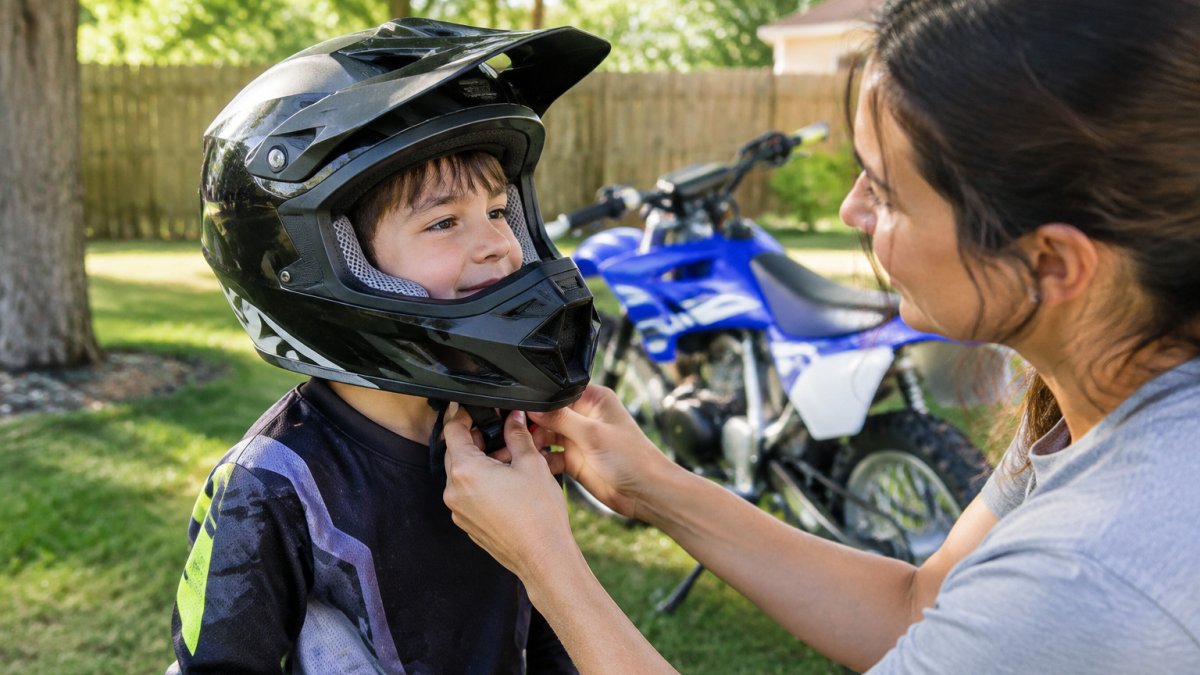
Fit is where most helmets fail. A helmet that rocks when the child shakes their head is too large, and a helmet that pinches at the temples is too small. Test the chin strap so you can fit one finger between it and the chin.
Testing data reinforces the point. One 2026 evaluation reviewed more than 100 children's helmets with a standardized rubric before narrowing its list to 12 top performers. Two Wheeling Tots evaluation of kids' bike helmets
Helmet Safety Standards: DOT and Snell Explained
Look for a DOT sticker on every helmet and check whether a Snell rating is also listed.
The helmet is the most important purchase, so these are the key checks the article recommends.
| Check | What to look for | Note |
|---|---|---|
| Under-5 helmet | CPSC 1+ | Extra rear-head coverage |
| Older children | Standard CPSC-certified helmet | Meets basic certification |
| Fit | Snug and level on the head | Rocking means too large |
| Chin strap | One finger fits under strap | Checks strap tension |
| Certification label | DOT sticker, optional Snell rating | Visible on the helmet |
| Helmet testing | 100+ helmets rated, 12 top picks | 2026 evaluation |
Why a Kids Dirt Bike Chest Protector Matters More Than You Think
A chest protector is one of the few pieces of gear that guards against serious injury from falls and handlebar impacts. Industry consensus treats chest and back protection as essential, not optional, for young riders. Vital MX Forums consensus on essential youth riding gear
Fit matters here too. A protector that rides up exposes the lower ribs and stomach. Choose a kid-sized model that covers the sternum and the upper abdomen when the child is seated on the bike.
Some riders argue that a well-fitted helmet and chest protector should come before any neck device. Forum riders with decades of experience often name those two items as the non-negotiable starting point for beginners. Max Off-Road discussion on neck braces versus helmet and chest protection
Selecting Kids Motocross Boots for Ankle and Foot Protection
Motocross boots protect the ankles, shins and feet from impacts and from the bike's footpegs. Look for a boot that is rigid enough to support the ankle but still lets a child shift and balance.
Fit should be snug without pinching the toes. Kids' feet grow quickly, so check sizing every season rather than relying on last year's pair. A boot that has lost its ankle support should be replaced, even if the sole still looks fine.
Goggles, Gloves and Knee Guards: Filling the Remaining Gaps
Goggles, gloves, and knee guards are the pieces parents most often buy last and kids most often refuse to wear, so fit and comfort matter as much as protection. A child who is distracted by pinching gloves or fogged lenses will ride worse and enjoy it less.
Goggles. Look for a youth-specific frame that seals against the face without pressing on the nose, and a lens that matches the light conditions. Clear or yellow lenses work for wooded trails and low light; tinted or mirrored lenses suit bright open tracks. A roll-off or tear-off system helps in muddy conditions, but for beginners a simple anti-fog lens is enough. Fit the goggle to the helmet opening so there is no gap at the brow.
Gloves. Youth gloves should be snug at the fingers with no loose fabric at the palm, since a slipping grip is a real hazard on rough terrain. Look for padded palms and knuckle protection. Avoid buying a size up; a glove that bunches at the fingertips reduces feel on the bars and can cause blisters.
Knee guards. There are two broad types: soft knee sleeves that protect against scrapes and light impacts, and hard-shell knee guards or knee braces that protect against twisting and direct hits. For a beginner, hard-shell knee guards offer a better protection-to-cost ratio. Knee braces are a bigger investment and are usually reserved for riders with a history of knee injury or aggressive riding.
Gear integration and comfort. This is where most kits fail. Layer a thin moisture-wicking base under the jersey so the chest protector does not chafe bare skin. Check that the knee guard strap sits below the boot cuff, not over it, or the boot will pinch. Make sure the goggle strap runs outside the helmet shell, not under it, so the helmet still fits correctly. A common pattern is for kids to quit wearing knee guards because the straps dig in behind the knee; a sleeve-style guard or a strap repositioned slightly lower often solves it.
Watch out: buying goggles or gloves a size up to extend their life backfires. Loose goggles leak dust at the edges, and oversized gloves slip on the grips, both of which increase the chance of a crash.
Prioritize goggles and gloves first, since they are inexpensive and address frequent hazards. Knee guards can come next, once the core kit is in place.
Building a Youth Dirt Bike Gear Package on a Budget
A complete youth kit does not have to mean a second mortgage, but the cost range is wider than most parents expect. The cost of a full beginner package depends on brand tier and whether you buy new or used. The helmet is the single largest line item and the one place where spending more is genuinely justified.
A practical way to think about the budget is in three tiers. The entry tier covers a CPSC- or DOT-certified youth helmet, basic goggles, youth gloves, a kid-sized chest protector, and entry-level motocross boots. The mid tier upgrades the helmet to a better-ventilated model and adds knee guards. The top tier adds a neck brace and higher-end boots with better ankle support. Most families are best served by putting the helmet and boots in the mid or top tier and saving on gloves, goggles, and pants.
Where to save and where not to:
- Buy new: helmet, chest protector, and boots. The helmet liner cannot be verified after a crash, and boot ankle support degrades invisibly.
- Safe to buy used: gloves, goggles (replace the lens if scratched), jersey and pants, and hard-shell knee guards with no cracks.
- Avoid used entirely: any helmet with an unknown history, and any chest protector with cracked plastic or compressed foam.
Watch out: a used helmet sold online may have been dropped or crashed even if the shell looks perfect. The foam liner compresses on impact and does not spring back, so the helmet can look fine and still offer far less protection than a new one.
A common pattern among riding families is to buy the helmet new at full price and stretch the rest of the budget by accepting hand-me-down pants and jerseys from older riders in the same club. That keeps the safety-critical items new while cutting the total cost substantially.
Pricing shifts by brand, size, retailer, and season, so check current pricing on the SalePriced website or request a quote for your child's setup.
Planning Your Child's Next Gear Upgrade and Replacement
Children outgrow gear faster than adults replace it, so plan replacements by size rather than by calendar year. Read how to choose the right size dirt bike to confirm the bike fits alongside the new gear. Check helmet fit, boot length and chest protector coverage at the start of each riding season, and again after any growth spurt.
Replace a helmet after any significant impact, and replace gear that shows cracks, loose straps or worn padding. For the warranty and safety case for new replacements, see benefits of buying new dirt bikes. Keeping the old kit "for the little one" only works when the older gear still fits and is in sound condition.
Whether your child is just starting out or moving up a size, the right gear makes every ride safer. Shop SalePriced for quality, safety-compliant equipment and find the setup that fits your young rider.
Frequently Asked Questions
What safety gear does a child need to ride a dirt bike?
At minimum, a child needs a properly fitted helmet, goggles, gloves, over-the-ankle boots, a chest protector, and long pants and a long-sleeve jersey. Many parents also add knee and elbow guards. Choose each item for the child's current size rather than buying oversized gear to grow into, since loose protection shifts during a crash. Check each helmet for a DOT label, and confirm sizing with a measuring tape before ordering online.
How should a dirt bike helmet fit a child?
A helmet should sit snug all the way around the head with no pressure points. It should sit level on the brow, roughly one finger width above the eyebrows, and not rock forward, backward or side to side when the child shakes their head. The chin strap should be tight enough that you cannot fit more than one finger under it. Re-check the fit each season, because children's heads grow quickly.
Can kids use regular motorcycle gear for dirt biking?
Adult motorcycle gear is generally too large for children and does not provide the same fit or flexibility needed for motocross. Youth-specific gear is sized for smaller bodies, so the protective pads sit in the correct position. If you are unsure, compare the child's measurements against the manufacturer's size chart before buying, and avoid hand-me-down items with worn padding or cracked shells.
What is the best chest protector for kids who go motocross?
Look for a youth chest protector that covers the sternum, ribs and upper back, with padding that stays in place when the rider leans forward. The right size should cover the chest without restricting breathing. Choose a model with adjustable straps so it can be tightened for a secure fit. Because children grow quickly, check the fit before each ride, and replace the protector if the padding is compressed or cracked.

0 comments